Studio and freelancer prices by style and length
These are the prices video studios and agencies publish in their own cost guides, including the freelancer rates they report. We read each guide on . Open Sources under a row to see its figures; the number after each source leads to the address of its page under Sources at the end. The typical price runs from the lowest to the highest figure listed in its row. Figures for other tiers or formats, such as premium studios, AI avatar videos, hourly rates or the full spread of a survey, are listed under Not counted and left out of the typical price. None of them are Vividemo prices.
A 60-second explainer, by who makes it. Published prices in USD as of November 2026.
DIY or AI tool
Typical price: $0–$500 a month
A subscription, not the cost of one video.
Sources (1)
- Epipheo[4]: $0–$500 a month in software fees
Freelancer
Typical price: $1,000–$5,000
AI-assisted studio
Typical price: $1,800–$6,000
Sources (2)
- explainervideos.ca[3]: AI-assisted explainers from about $2,500–$4,000
- WowMakers[5]: AI-accelerated whiteboard $1,800–$3,000 and 2D $3,000–$6,000
Not counted · 3D, live action and AI avatars
- WowMakers[5]: AI-accelerated 3D $5,000–$11,000 and live action $4,000–$11,000; AI avatar or presenter videos $1,200–$4,000
Studio
Typical price: $5,000–$15,000
Sources (3)
- Vidico[2]: $5,000–$15,000 a minute at small and mid-size studios
- explainervideos.ca[3]: $5,000–$10,000, its most common package
- Yum Yum Videos[1]: 61 quotes for the same brief (July 2026): median $9,680, average $11,420, median timeline 7 weeks
Not counted · The full spread of the 61 quotes
- Yum Yum Videos[1]: $2,800–$27,000, from the lowest quote to the highest
Premium agency
Typical price: $15,000–$50,000+
Bars use a log scale from $1,000 to $60,000; a faded end means the top figure is open-ended. Cost guides list DIY and AI tools as a monthly subscription, which doesn't tell you what one video costs. Three real bills are further down.
A 60-second explainer, by animation style, from studios and price guides. Published prices in USD as of November 2026.
Whiteboard
Typical price: $2,500–$5,000
Motion graphics
Typical price: $1,000–$10,000
2D characters
Typical price: $4,500–$15,000
3D
Typical price: $8,000–$25,000
Bars use a log scale from $1,000 to $60,000; a faded end means the top figure is open-ended.
Per finished minute, from animation price guides. Published prices in USD as of November 2026.
Motion graphics
Typical price: $1,000–$6,000
2D animation
Typical price: $2,500–$15,000+
3D animation
Typical price: $5,000–$50,000+
Bars use a log scale from $1,000 to $60,000; a faded end means the top figure is open-ended.
Length. Longer videos cost more, but not in proportion: each extra minute adds about half of the first minute's price, according to Piehole[10], and darvideo[9] puts a two-minute video at about 70–85% more than a one-minute one. Shorter videos don't get proportionally cheaper either, as the next section explains.
Why 30 seconds isn't half the price
A studio quote has a fixed part and a variable part. Discovery, the script, the style frames, the storyboard and project management happen once, whatever the length. Illustration, animation and sound grow with the runtime. Cut a video from 60 seconds to 30 and only the variable part shrinks, so a 30-second explainer usually costs more than half as much as a 60-second one.
AI generation has almost no fixed part. The 77-second Doc2Lang explainer, which used no generated footage, came to 145 credits in all, including the agent's planning, writing and editing, the narration and the music. Video models charge for every second they generate, so the rest of an AI bill follows the amount of generated footage: Vividemo's pricing page budgets a fully generated 30 seconds with Seedance 2.5 at 1,800–2,500 credits and 60 seconds at 3,200–4,500.
What doesn't shrink on either route is your own time: someone still writes the brief, reviews the plan and approves the cut.
What three real AI-made videos cost
Here is what three videos made with Vividemo actually used. The numbers come from their case studies, where you can watch each video and see what the credits were spent on.
 Watch Doc2Lang SaaS explainer
Doc2Lang SaaS explainer
1:17 · 16:9 · 1080p · English version
Motion graphics from real product samples, with narration, subtitles and music. No generated video.
145 credits ≈ $1.45
126 first cut + 19 revision
- Generated footage 0
- Voice and music 83
- Agent planning and editing 62
- Images 0
- Time
- 51 minto the first cut
- Cost of a revision
- 19 credits, 17 minone round of three changes
- Generated footage
- None
- Per finished second
- 1.9 credits
 Watch Science explainer: why astronauts float
Science explainer: why astronauts float
1:00 · 16:9 · 1080p
Motion-graphics diagrams, narration and music, plus two generated 3D shots of the astronauts (13 seconds in all).
740 credits ≈ $7.40
611 for the two 3D shots
- Generated footage 611
- Voice and music 60
- Agent planning and editing 49
- Images 20
- Time
- 34 minrequest to finished video
- Cost of a revision
- None requested
- Generated footage
- 13 of 60 seconds
- Per finished second
- 12.3 credits
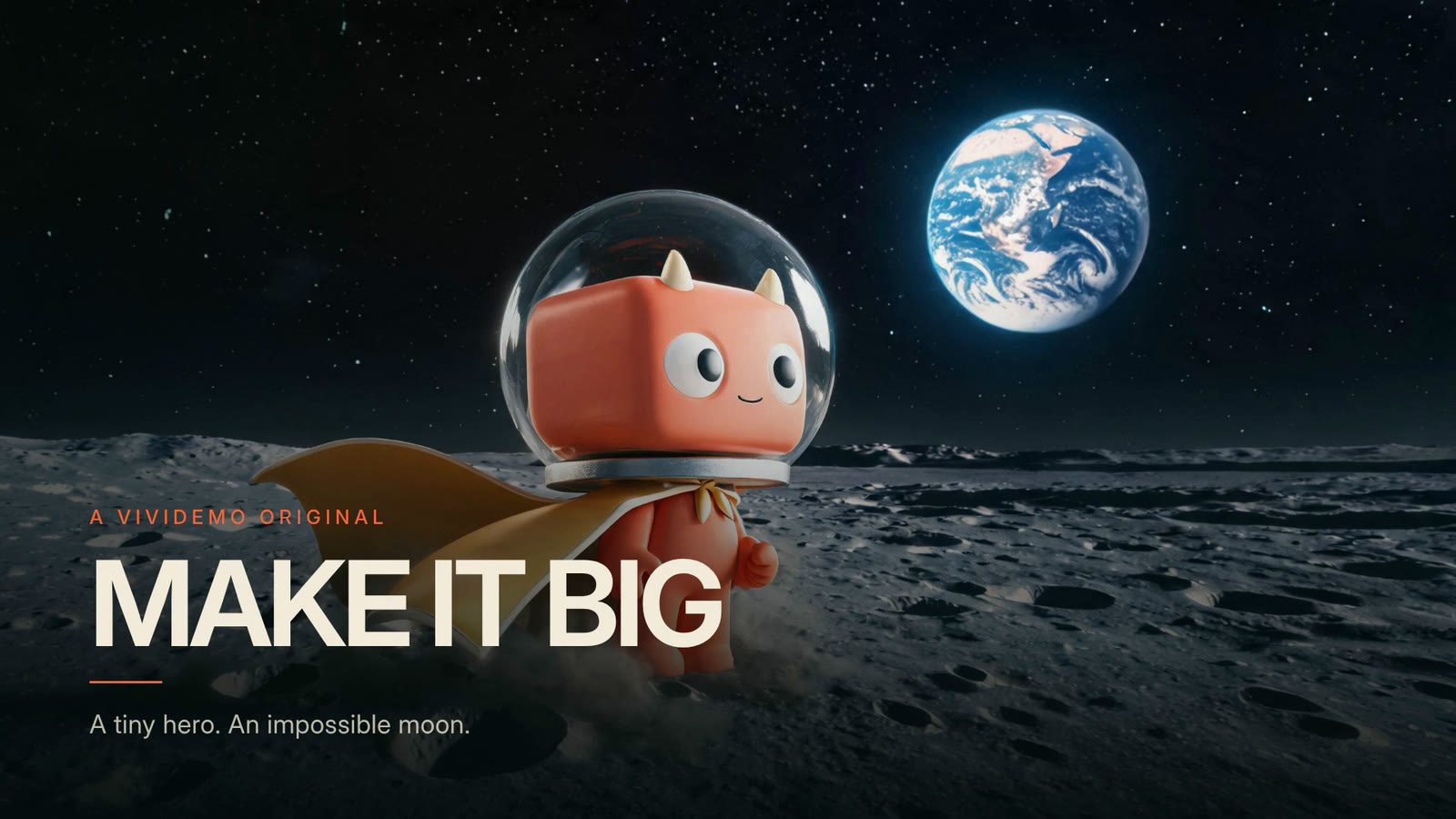 Watch AI animated short film: MAKE IT BIG
AI animated short film: MAKE IT BIG
3:03 · 16:9 · 1080p, upscaled from 720p
Five talking characters in stylized 3D: 25 Seedance 2.5 generations, voice lines and an original score.
11,576 credits ≈ $115.76
11,096 for the animated shots
- Generated footage 11,096
- Voice and music 299
- Agent planning and editing 55
- Images 126
- Time
- 2 h 11 minworking time to the first cut
- Cost of a revision
- 9 credits, 3.5 + 6 mintwo rounds of notes on the sound and edit
- Generated footage
- All 3:03, plus footage trimmed in the edit
- Per finished second
- 63.3 credits
How to read the bills
- Credits are each project's full metered usage, as shown on its case study: a record of what was used, not a quote or a fixed price. All three were made in November 2026 and checked against current pricing on November 9, 2026.
- Doc2Lang counts the English version only: the first cut and its one revision.
- The short film counts its full metered usage, 11,576 credits, the same figure as its case study.
- Times run from the request to the finished video, or to the first cut where noted. The short film's is the agent's working time, without waits for replies or a platform outage. None of them include your time writing the brief or reviewing.
- Dollar amounts convert credits at the base rate of 100 credits per $1. Plans work out to about 116–142 credits per $1, so the same videos cost less on a plan. Current credit pack prices are on the pricing page. Prices exclude tax.
Make your own explainer
Describe the video you need, or bring a script, a PDF or your own footage. The project page shows the credits used as the work goes.
What drives the cost of an AI explainer
The runtime matters less than how the picture is made:
That's about 2 credits per finished second without generated footage, against about 63 for the short film, where every shot is generated. Five things set the cost:
- Seconds of generated footage. The biggest factor, as the scale shows. A video model charges for every second it generates.
- The model. Video models are priced differently. For 60 seconds with every shot generated, the estimated video budgets on our pricing page plan 2,500–3,500 credits for a simple social video with H3 Max at 1080p and 3,200–4,500 for a cinematic video with Seedance 2.5 at 720p.
- Resolution. With the same model, a higher resolution costs more per generated second.
- Retakes. Every generated take is billed, including footage that doesn't make the final cut: the short film's 63 credits per finished second include footage trimmed in the edit. Vividemo shows you the problem and asks before generating again, unless you left production decisions to it; then it retries a shot at most three times.
- Motion graphics versus generated shots. Text, diagrams, interface screens and data built as motion graphics cost little and stay exact. The science explainer kept its diagrams as motion graphics and generated only the two shots of the astronauts.
Revisions follow the same rule. Changes to the edit, narration or music cost little: Doc2Lang's round of three changes used 19 credits. A regenerated shot costs about as much as the first take.
What a studio fee buys that credits don't
A studio price pays for people and accountability as well as footage. Most quotes cover:
- Strategy and a human script. A producer and a writer work out the message with you, then write and refine the script.
- Art direction. Custom illustration and characters in your brand style, kept consistent across a campaign.
- Managed revisions. Feedback rounds built into the schedule, with a project manager collecting comments from everyone who signs off.
- Someone accountable. A contract, a delivery date and a team responsible for the result, with the rights to the music, voices and files set out in the agreement.
Vividemo's agent plans the video, writes the script and makes it, but you're the creative director: you write the brief, approve the direction, review the cut and decide what changes. Credits pay for the work the agent and the AI models do. They don't buy a team's judgment or a contractual commitment.
When a studio is the better choice
- A flagship brand film or a broadcast ad.
- Character animation in a custom style that has to stay consistent across many videos.
- Technical 3D, such as product internals, that has to be exactly right.
- Live action with real people, places or your product on camera.
- Nobody on your team has time to direct the video.
AI fits onboarding and tutorial videos, product updates, training, social cuts and versions in other languages, and it lets you test an idea before you commit a studio budget. Studio guides from WowMakers[5], Vidico[2] and Epipheo[4] draw a similar line. For testimonials, recruitment videos and other corporate videos with real people on camera, our corporate video guide sets out what you film yourself and what AI can do.
Hidden costs on either route
Quotes and credit bills both leave things out. These are the usual extras.
On a studio quote
- Rush delivery: +25–50% (Epipheo[4]).
- Each extra revision round: 8–12% of the project (Epipheo[4], explainervideos.ca[3]).
- Voiceover: $300–$1,000 per minute for professional voice talent (Vidico[2]).
- Localization: $300–$600 for each extra language version of a 1–2 minute video (Blue Carrot[11]).
- Source files or a buyout: +20–30%. WowMakers[5] charges 20% for the working files and Blue Carrot[11] a 30% buyout fee.
On AI credits
- Retakes: a shot generated again is billed again, and so is footage trimmed in the edit.
- Music: each new version of a score is another generation. The short film's score was made twice, for 285 credits in all.
- Other aspect ratios: a 9:16 version of a 16:9 video costs little when the shots can be reframed, but shots composed again for the new frame are billed as new footage.
Whether you can use an AI-made video commercially depends on the licenses of the models and music used; the FAQ explains how that works with Vividemo.
Estimate your budget in three steps
- Split the runtime. Mark the seconds that need generated footage, such as people, characters or real-world scenes, and the seconds that can be motion graphics: text, diagrams, screenshots and data.
- Price each part. Motion graphics with narration and music came to about 2 credits per finished second in the Doc2Lang explainer. Generated footage came to about 63 credits per finished second in the short film, where every shot was generated, and the budgets on our pricing page cover 30 and 60 seconds by model.
- Leave room for changes. Add headroom for shots you may want to redo. Edits to the cut, narration or music cost little, and the project page shows the credits used as charges are recorded.
Example: 47 seconds of motion graphics and 13 seconds of generated shots come to about 47 × 2 + 13 × 63, or roughly 910 credits. The science explainer had exactly that mix and used 740, so the estimate leaves some room.
Explainer video cost FAQ
How much does a 60-second explainer video cost?
The studio price guides we checked in November 2026 put a 60-second explainer at about $5,000–$15,000, and the median of 61 studio quotes in Yum Yum Videos' July 2026 survey was $9,680. Freelancers typically charge $1,000–$5,000. With Vividemo, a 60-second explainer with two generated 3D shots used 740 credits (about $7.40), and a 60-second video with every shot generated is budgeted at 2,500–4,500 credits (about $25–$45). Credits are metered usage, not a fixed price, and they don't count your own time on the brief and reviews.
Are explainer videos priced per second, per minute or per project?
Studios and freelancers quote per project. Per-minute prices are a shorthand for comparing quotes, and they don't scale evenly: in the price guides we checked, a second minute adds about 50–85% of the first minute's price. Vividemo uses neither. It charges credits for the work actually done, such as the agent's planning and editing, images, narration, music and each generated shot, so the cost depends more on how much footage is generated than on the length.
Is a 30-second explainer half the price of a 60-second one?
Not at a studio. Discovery, the script, the storyboard and project management cost about the same at any length, so 30 seconds usually costs more than half as much as 60. Generated footage has almost no fixed cost, so its cost follows the runtime more closely: Vividemo's pricing page budgets a fully generated 30 seconds with Seedance 2.5 at 1,800–2,500 credits and 60 seconds at 3,200–4,500.
How long does it take to make an explainer video?
The median timeline in Yum Yum Videos' July 2026 survey of studio quotes was 7 weeks. With Vividemo, the 60-second science explainer took 34 minutes from request to finished video, the 77-second Doc2Lang explainer reached its first cut in 51 minutes, and the 3-minute animated short film took 2 hours 11 minutes of working time to its first cut. Add your own time to write the brief and review the cuts.
How much does a revision cost?
Studios include a set number of revision rounds, and the price guides we checked put each extra round at 8–12% of the project. With Vividemo, a revision costs the work it takes: Doc2Lang's one round of three changes took 17 minutes and 19 credits, and the short film's two rounds of notes on the sound and edit cost 9 credits together. Regenerating a shot costs about as much as the first take.
Should I use AI or a studio for an explainer video?
Choose a studio for a flagship brand film, custom character animation, technical 3D that has to be exact or live action, or when you want a team to own the strategy, script and revisions. AI suits onboarding and tutorial videos, product updates, training, social cuts and other languages, and it lets you try an idea before you commit a studio budget. With Vividemo you're the creative director: you write the brief, approve the direction and review the cut.
Who owns the video, and can I use it commercially?
Vividemo doesn't claim ownership of the videos it makes for you. Whether you can use one commercially depends on the AI models and music used, their licenses and how you plan to use it. You also need permission for any footage, logos, voices or likenesses you upload. Our terms list the licenses that apply; contact us if your intended use is unclear.
Is there a watermark?
Vividemo doesn't add a watermark or logo to the videos you export.
Do I need a subscription?
No. Credit packs are one-time purchases, and their credits don't expire. Monthly or annual plans are optional: they cost less per credit, but each month's plan credits expire at the end of that month. See plans and credit packs.
Compare plans and one-time credit packs, or open a case study to follow a project from the brief to the finished video. Planning an ad instead? See how much it costs to make a commercial.
Sources
Numbered in the order this guide first cites them. Every page was checked on .
- Yum Yum Videos, “How Much Does an Explainer Video Cost in 2026?” https://www.yumyumvideos.com/blog/how-much-does-an-explainer-video-cost/
- Vidico, “How Much Does Animation Cost? Complete Price Guide (2026)” https://vidico.com/news/how-much-does-animation-cost/
- explainervideos.ca, “Explainer Video Cost : How Much Per Minute + Video Cost Calculator” https://explainervideos.ca/explainer-video-cost/
- Epipheo, “How much does an explainer video cost?” https://epipheo.com/explainer-video-cost/
- WowMakers, “How much does an explainer video cost in 2026?” https://www.wowmakers.com/explainer-video/
- Moonb, “How Much Does Animation Cost? A Practical Breakdown” https://www.moonb.io/blog/how-much-does-animation-cost
- Mammothic Films, “How Much Does Animation Cost? (2026 Price Guide)” https://mammothicfilms.ca/how-much-does-animation-cost/
- Magic Motion, “How Much Does an Animation Video Cost in 2026? Complete Pricing Guide” https://magicmotionstudio.com/animation-video-cost/
- darvideo, “Animated Video Cost in 2026” https://darvideo.tv/blog/animated-video-cost-in-2026/
- Piehole, “How much does an Explainer Video Cost?” https://piehole.tv/explainer-video-cost/
- Blue Carrot, “Explainer video production pricing guide” https://bluecarrot.io/blog/explainer-video-production-pricing-guide/