Example project · PDF to video
Why do astronauts float? A 60-second science explainer.
Jump to a part of the film
We gave Vividemo a 176-page teacher's guide from NASA and one request. It took three ideas from the guide — gravity, free fall and orbit — and made a narrated, captioned explainer with two animated astronauts.
- Request
- One message
- Revisions
- None
- Request to finished video
- 34 minutes
- Credits used
- 740
The PDF and the request
Nobody named pages or wrote a script. Vividemo read the guide, picked the passages that explain gravity, free fall and orbit, wrote the narration and dialogue, and chose how each idea would look.
1 · The PDF
- Publisher
- NASA, EG-1997-08-110-HQ
- File
- 176-page PDF, 10.7 MB
- Rights
- Public domain, as stated on its title page
2 · The only message sent
3 · The video
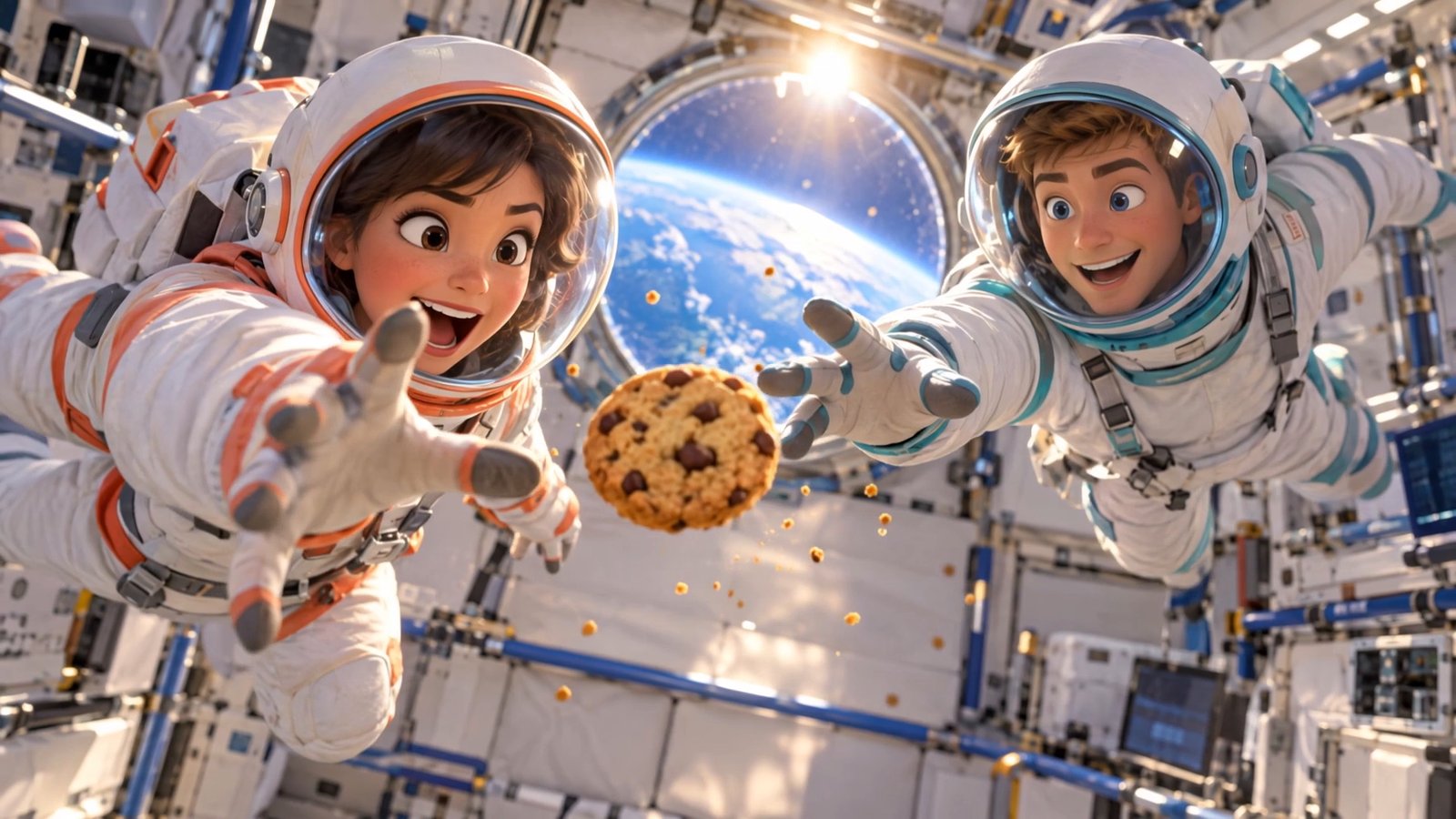
60-second explainer
- 1920×1080, narration and dialogue
- Captions in the video, plus an SRT file
- Source credit at the end
Delivered 34 minutes later, with no revisions.
Have a PDF of your own? Start with one message, the way this project did.
Make a video from your PDFFrom the guide to the screen
Each explanation in the film comes from a specific page of the guide. The page images are cropped from the uploaded PDF; page numbers count pages in the PDF file, with the printed page number in brackets.
01 Gravity never turns off
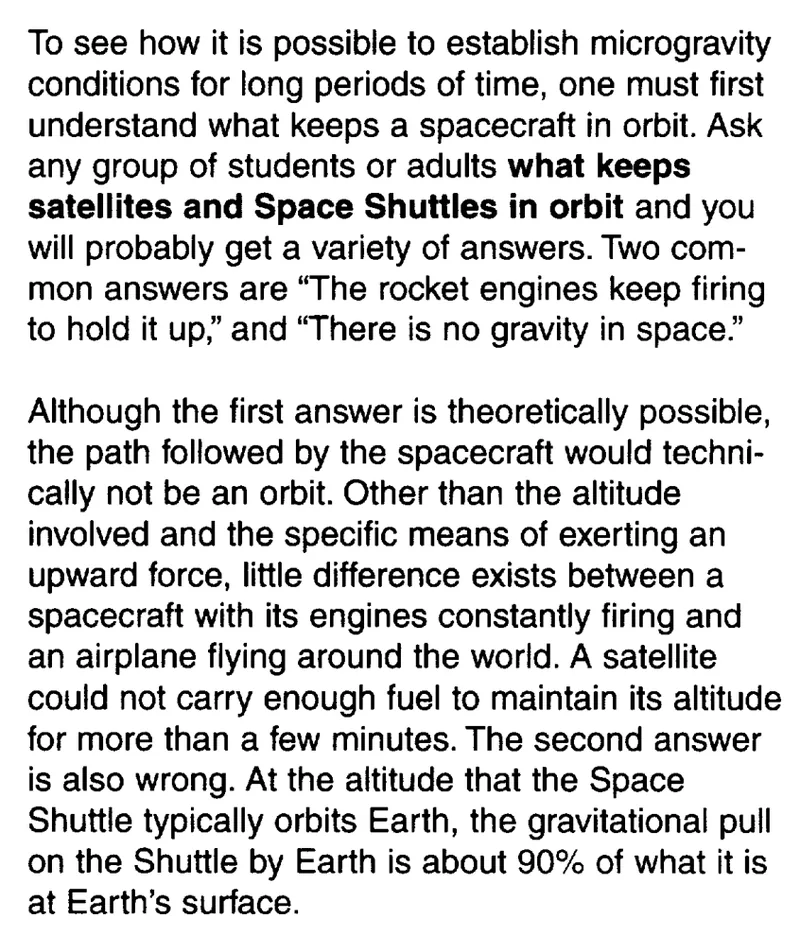
0:12–0:21In the guide
“At the altitude that the Space Shuttle typically orbits Earth, the gravitational pull on the Shuttle by Earth is about 90% of what it is at Earth's surface.”
PDF page 18 (printed page 10) In the film · 0:19
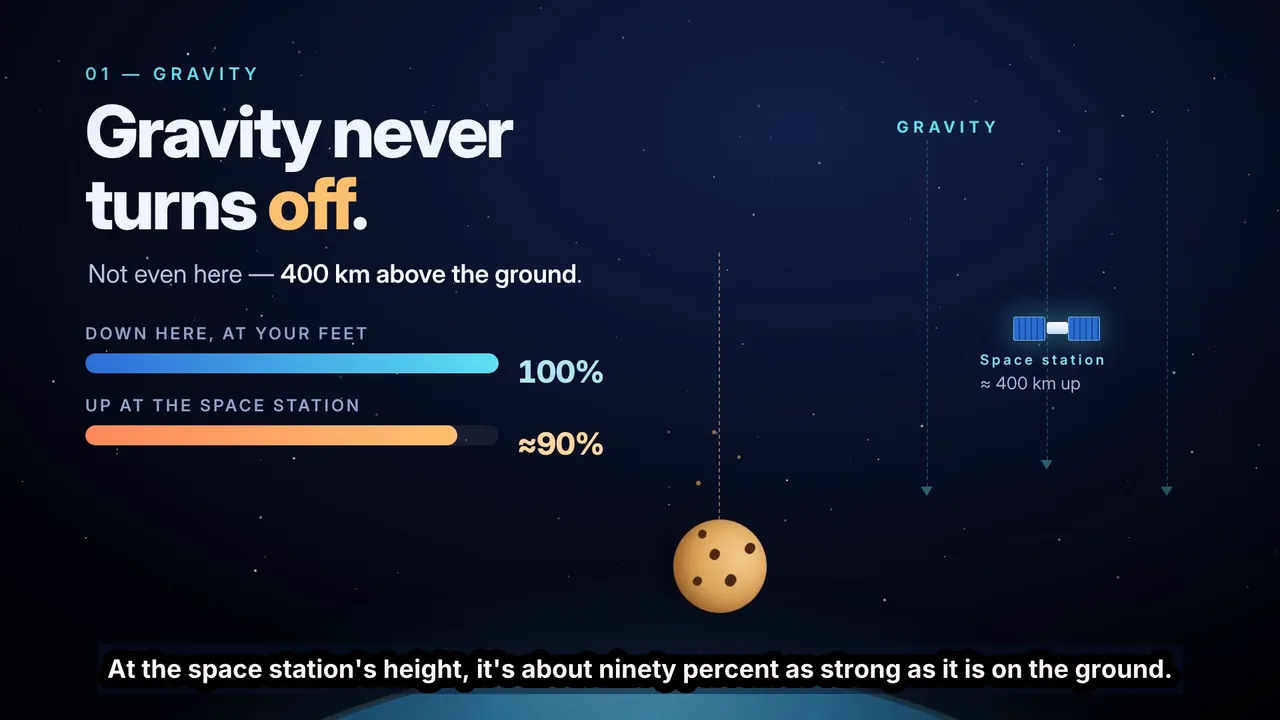
Narration“Surprise: gravity is still there. At the space station's height, it's about ninety percent as strong as it is on the ground.” The guide answers a common belief, “There is no gravity in space,” with a single number: about 90% of surface gravity at orbit height. The film turns that number into two bars a viewer can compare at a glance.
02 Everyone's falling
0:21–0:33In the guide
“No weight is measured in the last car on the right because of free fall.”
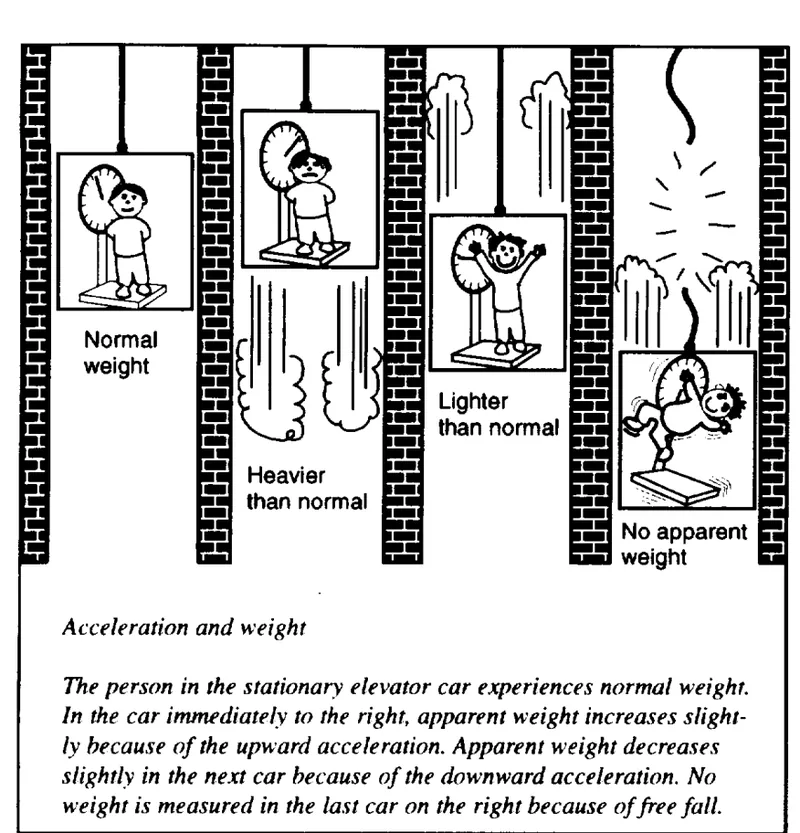
PDF page 13 (printed page 5) In the film · 0:31
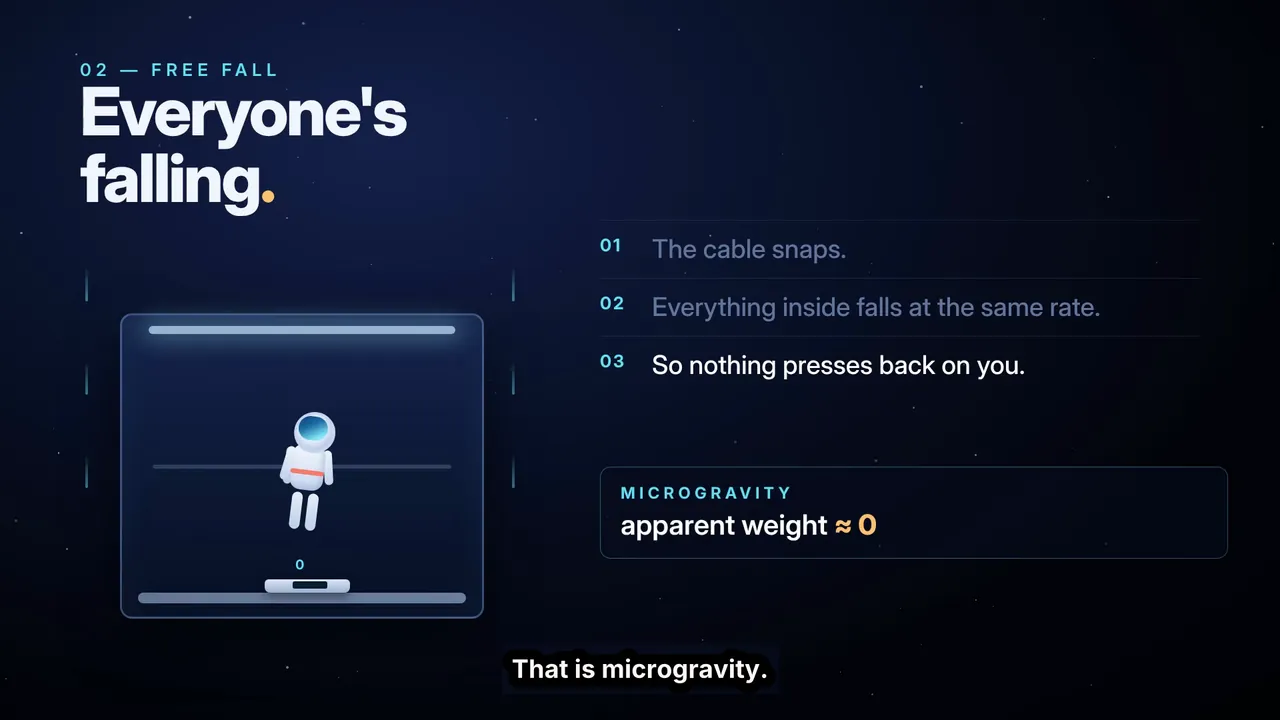
Narration“Imagine a falling elevator. You, the scale, and the floor all drop at the same speed — so nothing presses on you. You float. That is microgravity.” The guide draws four elevator cars side by side. The film keeps only the last, falling car and animates it: the cable breaks, the astronaut lifts off the scale and the reading drops to zero. The closing card, “apparent weight ≈ 0”, follows the guide's definition on the same page: microgravity is when the apparent weight of a system is small compared to its actual weight.
03 The art of missing
0:33–0:47In the guide
“At that speed and altitude, the Shuttle executes a falling path parallel to the curvature of Earth.”
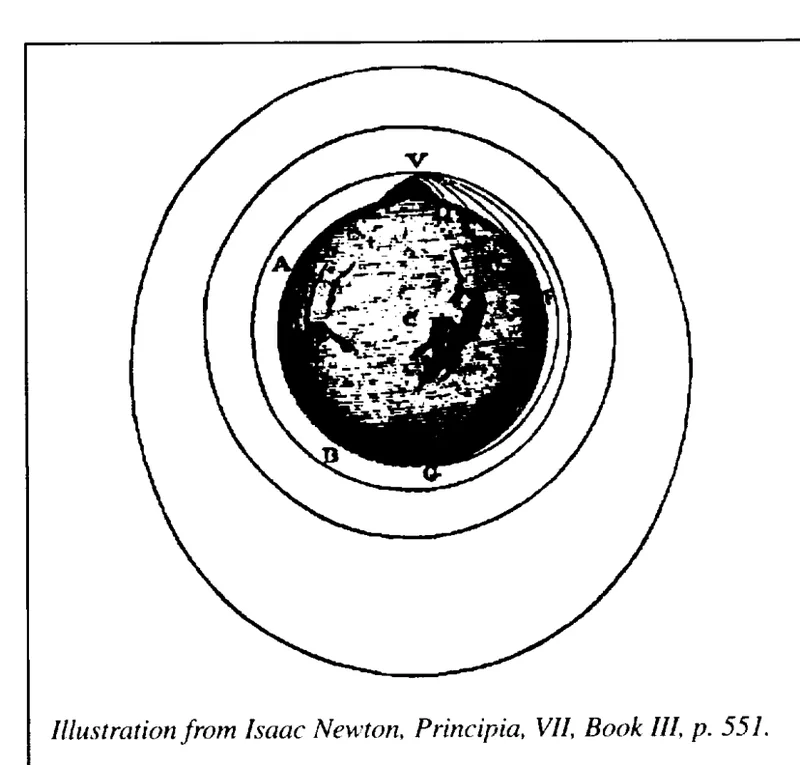
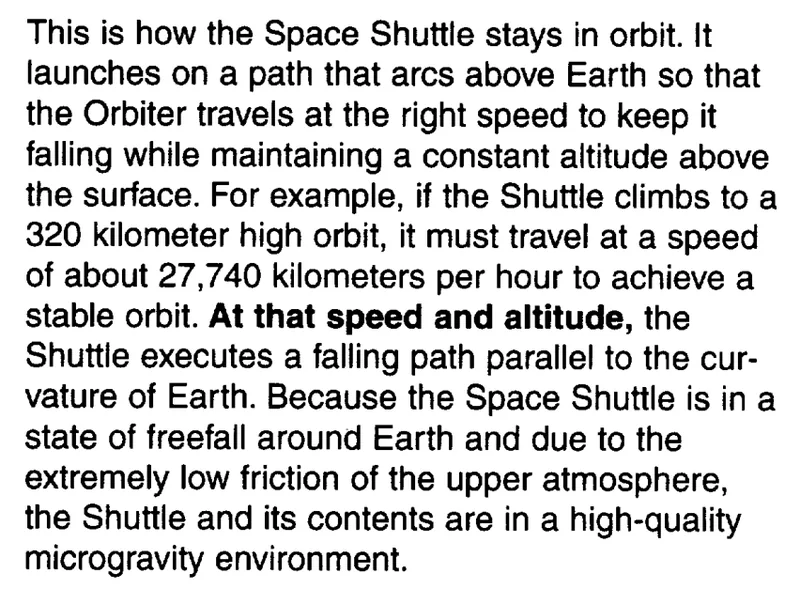
PDF pages 19–20 (printed pages 11–12) In the film · 0:45
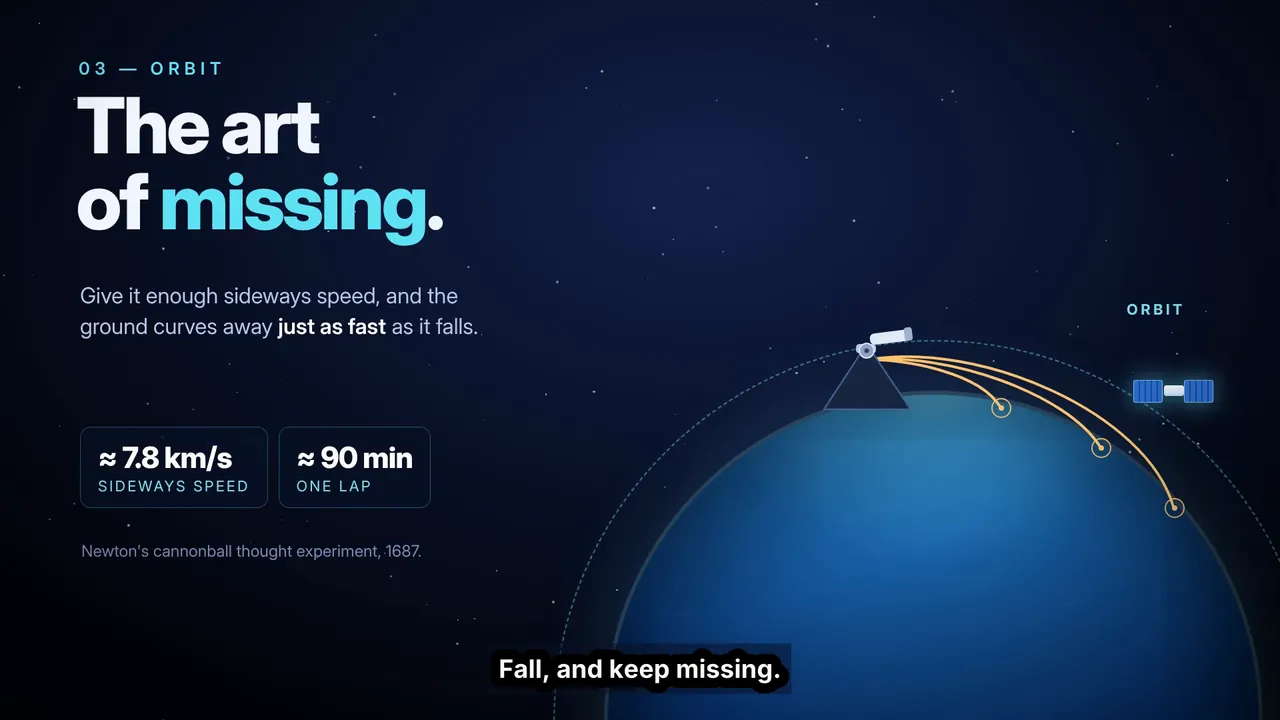
Narration“The station is falling too — while racing sideways at about eight kilometers a second. Fast enough that the ground curves away as fast as it falls. Fall, and keep missing. That's an orbit.” The film redraws Newton's cannonball drawing as motion: each shot flies farther, and the last one keeps falling without reaching the ground.
How the 60 seconds are built
The request asked for an opening with two astronauts chasing a snack, so the film acts the question out before it asks it. Each explanation gets one idea and one picture, and the ending returns to the same cookie so the last line can answer the title.
- The two astronauts
- Explanation from the guide
- Title and source credit
- 0:00Cold open
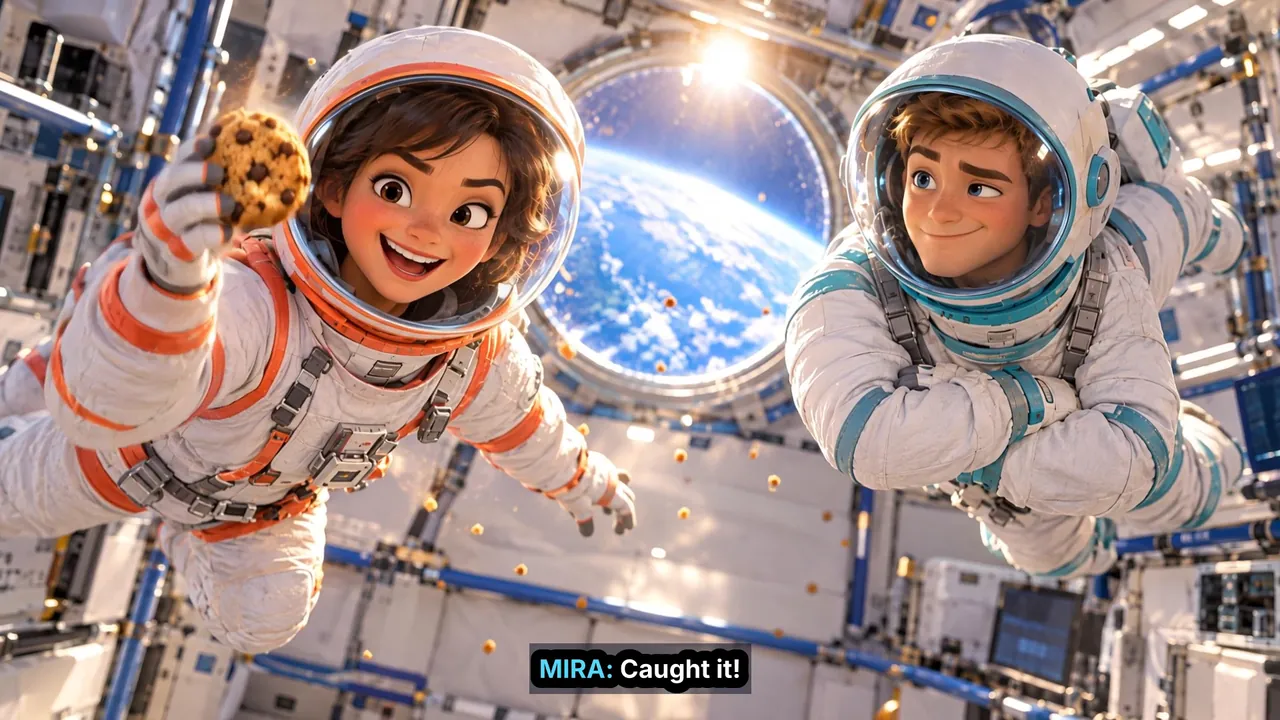
Mira and Theo lunge for a floating cookie, nearly bump helmets, and watch it drift away. “Got it—!” “No, I've got—!” “…Where'd it go?”
- 0:07Title
“Why do astronauts float?” The narrator sets up the question: “Astronauts float. But almost nobody can tell you why.”
- 0:12Gravity · Free fall · Orbit
Three explanations, one idea and one picture each. Compare them with the guide.
- 0:47Payoff
Mira catches the cookie and takes a bite. “Caught it!” “Show-off.” The narrator closes: “Not because gravity is gone. Because they're falling — together.”
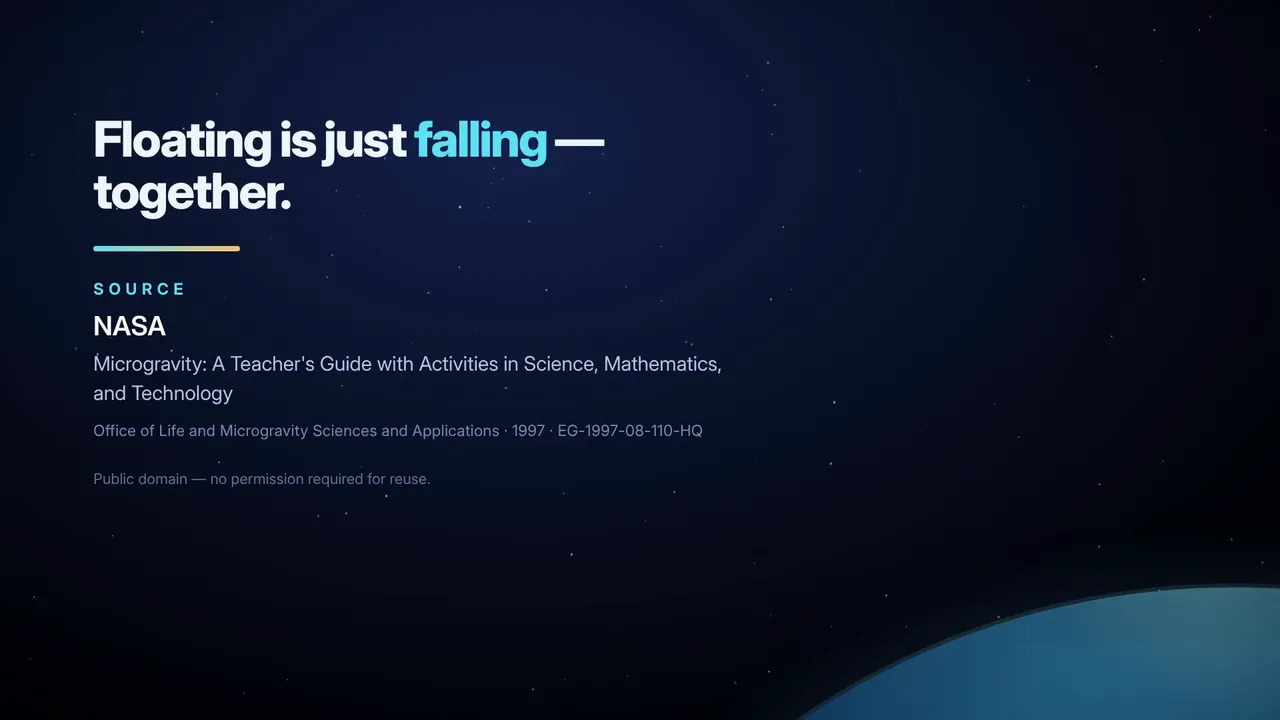
- 0:55Source credit
The guide's title and publisher, as the request asked.
What it took
Credits used by this project
740
- The two 3D shots of the astronauts
- 611 credits
- Keyframes, voices, music, and the agent's reading, planning and editing
- 129 credits
This is what this one video cost, not a fixed price: credits depend on length, how many shots are generated and how many changes you ask for. See pricing for plans and credit packs.
| Part of the video | Made with |
|---|---|
| Two 3D shots of the astronauts (7 s and 6 s) | Kling 4.0, starting from keyframes made with GPT Image 2.5 Flare |
| Title, gravity, free fall, orbit and credit scenes | HyperFrames motion graphics |
| Narrator and two astronaut voices | ElevenLabs v4 |
| 60-second instrumental score | ElevenLabs Music v2 |
| Edit, burned-in captions and loudness | FFmpeg |
| Final check of the mixed audio against the script | Whisper Large v3 |
Vividemo chose these models while planning; the request did not name any. Only the two 3D shots were generated as video. The diagram scenes were built as motion graphics, so their labels, numbers and lines stay exact.
What was delivered
- MP4 video
60 seconds, 1920×1080, 30 fps, H.264 video with stereo AAC audio.
- Captions in the video
Burned in, with the two astronauts' lines labeled by name.
- SRT caption file
A separate file you can edit or upload to a video platform.
Download the SRT file - Source credit
At the end, naming the guide and its publisher.
Turn your own PDF into a video
Upload a PDF, say who the video is for and how long it should be, and describe anything you want in it — a scene, a character, a tone. Vividemo reads the document, plans the video and shows the credits it uses as it works.
Source material: NASA, Microgravity: A Teacher's Guide With Activities in Science, Mathematics, and Technology (EG-1997-08-110-HQ). Created with Vividemo using NASA's Microgravity Teacher's Guide as source material. This example is not affiliated with or endorsed by NASA.